The Easter Journey from Lament to Praise
share
By Sister Julia Upton
In 2020, when our churches were closed due to the pandemic, I wondered how we would be able to celebrate Holy Week and the Easter season, but the way was shown. This year I admit to having some of those same questions, not because our churches are shuttered but because our hearts have been shattered. It breaks my heart to see the Middle East, that holy land where civilization began, aflame in war yet again. How do we make the journey now from lament to praise?
Besides Mary Magdalene, the image of lament that stands out for me at this time of year is of Pope Francis. In the early evening of March 27, 2020, Pope Francis walked alone, without even an umbrella, through an uncharacteristically empty, rain-soaked St. Peter’s Square. Slowly, he crossed the square and climbed the steep path leading to the Sagrato in front of the Basilica where he began to pray with us. This “extraordinary moment of prayer,” as it was called, was powerfully stark. The gospel (Mark 4:35-41) was chanted slowly; Pope Francis preached tenderly, embracing humanity’s shared anxiety, reminding us that God “will not leave us at the mercy of the storm.” He slowly walked to the icon of Virgin Mary, Salus Populi Romani, which had been moved from its usual place of veneration at the Basilica of St. Mary Major. Before and after every trip, and on every Marian feast, Pope Francis went there to pray before the icon. Over the centuries, it had been carried in procession through the city in times of crisis and war. Next Pope Francis moved to pray before the miraculous crucifix, survivor of plagues and fires, which had been brought from the Church of Saint Marcello. Only then did he move into the basilica to continue the service. I become verklempt each time I recall that evening of solemn prayer, known as the “Statio Orbis,” the Station of the World.
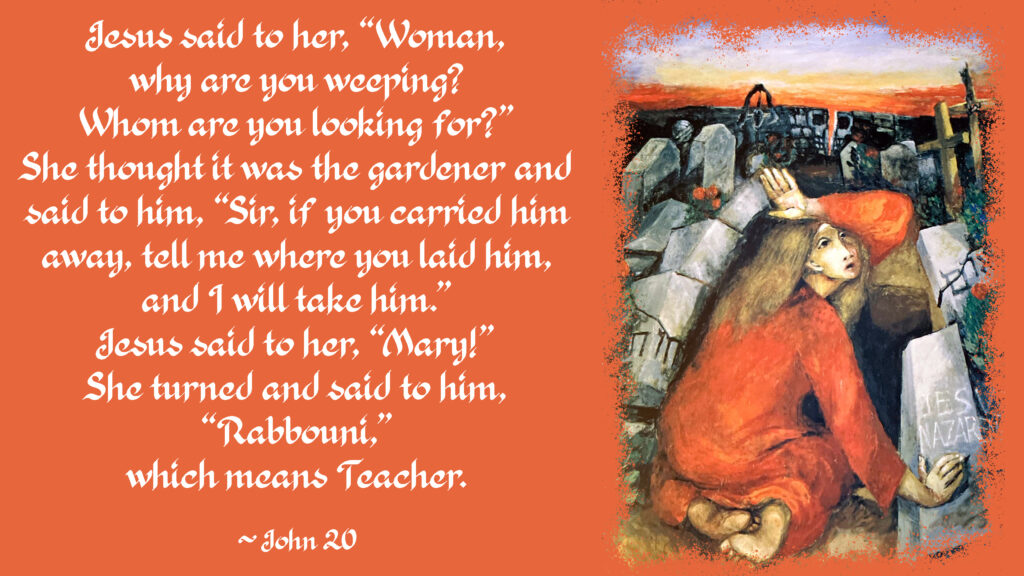
Against this solemn backdrop, I see Mary Magdalene, distraught with grief, weeping at the empty tomb. In this painting by the late German priest and artist, Sieger Köder, Mary looks up in surprise and confusion until she hears her name called. What power there is in hearing our name! In that moment, everything falls into place. She moves from lament to praise, from grief to mission, becoming apostle to the Apostles.
Listen! You might hear Jesus call your name softly, transforming your grief into mission, joining the company of apostles of hope, peace, and love throughout these fifty days and beyond.