donate
View last year’s grand prize winning video. (*Note: the contest themes have changed for 2026.)

The Mercy Justice Team needs you, a Mercy student, to create a short, social media style PSA (public service announcement) video – think Reels or TikTok – that reflects the Sisters of Mercy’s Critical Concerns. Put those creative ideas and video skills to work and you could win $500!


What does it mean to allow others to be fully human without judgment?

The 2026 contest theme is: Embracing Dignity and Respect. Through the lenses of the Mercy Critical Concerns and the Core Values of Mercy Education, use your video to engage one of these ideas:

How can we stand up with others or stand up for others?

How can we go beyond tolerance to embrace diversity?


To receive information, updates and reminders about this year’s contest, sign up here and we’ll be in touch. Click here to learn rules for entry and how to upload your video.

View the grand prize winning video from 2024. (*Note: the contest themes have changed for 2026.)

Purpose

For this year’s contest we are seeking short, PSA style videos (30 to 90 seconds) that are suitable for sharing on social media platforms such as TikTok or Reels. In an increasingly divided and polarized world, your video should reflect the charism of Mercy and connect to one or more of the Mercy Critical Concerns. Videos could focus on:

Why it is important to value or celebrate our differences

Encouraging support of oppressed or marginalized groups in society

A story of standing in solidarity with others


Contest Webinar

Watch our 13 minute webinar to learn more about this year’s contest.


Who Can Enter

Any student or group of students, high school age or older, enrolled in Mercy high schools, colleges/universities, or involved in a Mercy-affiliated ministry.

Use this tip-sheet to help you as you begin the process of creating your video.

Format

Read the complete rules

Length: 30 to 90 seconds

Language: English or Spanish

Other Requirements

1. Title. Each video must have a title. The title must be indicated on the submission form. The title does not need to be included in the video itself.

2. Credits. Credits must include the name of those involved in the creation of the video. The credits must also include citations for any images, audio, or text used in the video that is not original. The credits do not need to be included in the video itself, but must be included in the submission form.

The Sisters of Mercy may delete title and credit screens before posting videos on social media.

Entrants are strongly encouraged to use original footage and graphics as much as possible.

Important Note on Rules: In order to honor copyright protections, rules regarding use of images and music were updated for the 2022 contest and remain in effect for 2026. See the complete rules for details.

Deadline

All entries must be received by April 1, 2026.

Prizes

A panel of judges will use these criteria to select the winning video. Individual winners will receive financial awards. The Grand Prize Winner receives $500.

Winning entries may be featured on the Sisters of Mercy Institute web site and social media channels. Winners and their winning institution will be formally announced.

Interested?

If you think you might be interested in entering this contest, fill out this form to receive contest information and updates.

Past Winners

Click here to view all of our past winners.

By Marianne Comfort, member of the Mercy Justice Team

Mercy schools in Jamaica offer inspiration for how educational institutions can adopt environmentally sustainable practices in response to our critical concern for Earth. 

Alpha Primary School, Jessie Primary School, Alpha Academy and the Alpha Vocational Training Centre share one campus in the capital city of Kingston. 

This year 10 clearly marked recycling bins were installed on the property to engender a culture of recycling and sustainable waste management among students and staff.  

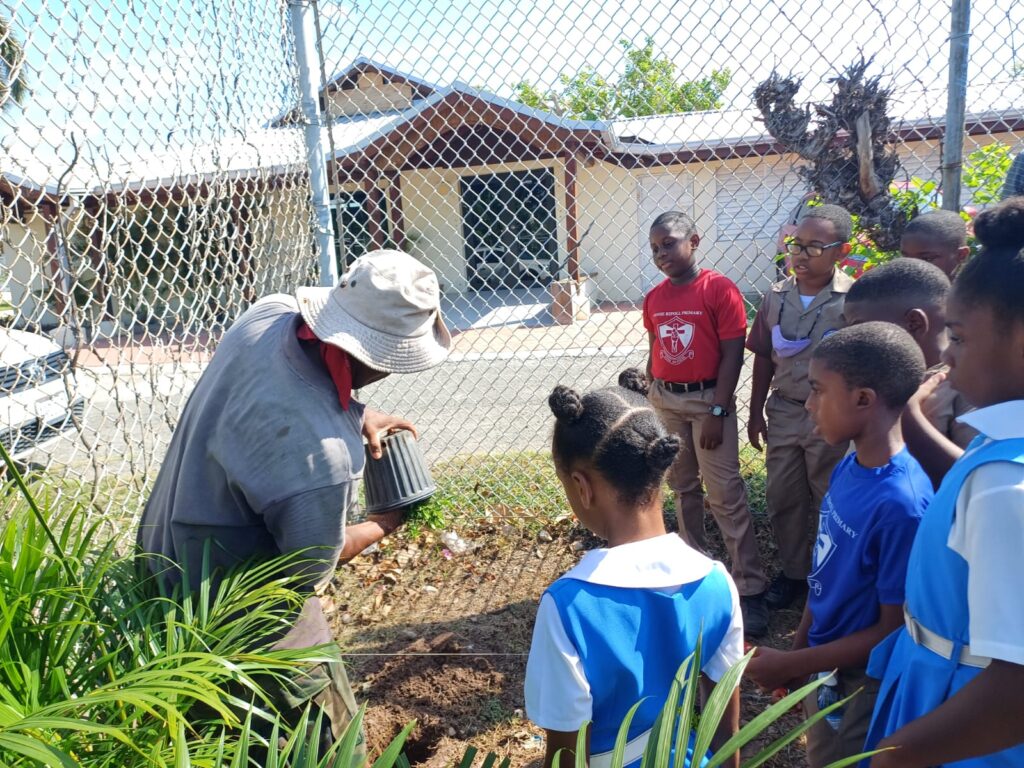
Guided by two gardening experts, students from the four schools planted a variety of trees and other plants in a memorial garden that honors sisters who had been instrumental to the schools’ success. Throughout this process, students learned the plants’ features, names, uses and more.  

Older students formed groups in which they designed and planned campaigns to tackle water shortage, waste management, deforestation and other issues.  

Finally, students took turns making personal pledges to engage in actions that mitigate the effects of climate change. 

The schools look forward to creating more opportunities for students and staff to care for the Earth, including through a compost heap now being planned. 

By Sisters of Mercy Staff

Dr. Tracey Woodruff from the University of California in San Francisco recently published an article about effective ways to reduce exposure to microplastics.

We have covered the concern of microplastics in previous Green Tips articles, but if you are interested in reading more refer to this article: “Effects of Microplastic Exposure on Human Digestive, Reproductive, and Respiratory Health: A Rapid Systematic Review.”

Some suggestions for reducing your exposure to microplastics include:

  • Eat food prepared at home to minimize processed and fast foods. 
  • When eating out, look for restaurants that are trying to be more sustainable, especially in the use of non-plastic packaging (e.g., Wendy’s uses customer-facing packaging made from cardboard sourced from sustainably managed forests). 
  • Look for condiments that come in glass jars. Minimize your overall consumption of foods packaged in plastic. 
  • Pack your own meals when traveling.
  • Microwave food in glass instead of plastic containers.
  • Minimize the purchasing of frozen vegetables in plastic packaging.  At a minimum, transfer frozen vegetables to a non-plastic container prior to microwaving.
  • Avoid purchasing water packaged in single-use bottles.
  • Resist the urge to use plastic produce bags when purchasing fresh fruits and vegetables.
  • Cook food in stainless steel or cast-iron instead of nonstick pots and pans.
  • Eat as low in the food chain as possible (e.g., fruits and vegetables). Larger animals and fish tend to have higher concentrations of harmful chemicals.
  • Dust often and use a vacuum with a HEPA filter. Microplastics in the air tend to cling to dust, so it is important to remove dust and to use a vacuum that can filter very fine particles from the air.
  • Use fragrance-free cleaning and personal care products.

Attempting to follow all of these suggestions can seem like a daunting task.  Try to address one at a time until they eventually become a necessary habit.

By Sisters of Mercy Staff

As we move into warmer months, many of us are finalizing travel plans for the summer. The way we travel though can have a substantial impact on the environment. So how do we know when to take a train, plane, automobile, or bus? We will consider this question from the standpoint of trying to minimize the amount of greenhouse gas emissions created. 

Emissions due to travel are dependent on the following:  

  • fuel mileage (miles per gallon or mpg) 
  • the amount of gas emissions created for each gallon of fuel, or each kWh of electricity used 
  • the number of people traveling with you.  

1. Fuel Mileage: Fuel mileage varies considerably depending on the type of transportation and the extent to which transportation depends on electricity vs. liquid fuel (e.g., gasoline, diesel, jet fuel). The average estimated mileage for various transportation and fuel types is given below: 

  • Automobiles (all): 28.3 mpg 
  • Automobiles (hybrid): 50.0 mpg (represents the low end of the expected range of fuel mileage for a 2024 Toyota Prius, which can get up to 57.0 mpg.) 
  • Domestic Flights (jet fuel): 0.50 mpg 
  • Transit Trains (diesel): 6.9 mpg 
  • Amtrak Trains (electric): 0.10 miles per kWh 
  • Transit Bus (diesel): 4.0 mpg 
  • Intercity Bus (diesel): 6.4 mpg 

2. Carbon Emissions per Gallon: This measures the carbon emissions that are created for each gallon of fuel or kWh of electricity consumed. Estimates are given below as pounds of carbon dioxide equivalent (CO2e) per gallon of fuel or electricity. Note: the term “carbon dioxide equivalents” refers to the combined impacts of all greenhouse gases. 

  • Gasoline: 20.86 pounds of CO2e per gallon 
  • Diesel: 22.45 pounds of CO2e per gallon 
  • Jet Fuel: 21.50 pounds of CO2e per gallon 
  • Electric: 0.81 pounds of CO2e per kWh 

3. Number of People: If you are in a car with one other person, you are responsible for half of the emissions created during the trip. If you are on a plane with hundreds of people, you are responsible for a smaller portion of the emissions created by the plane. The values provided below are rough averages of the number of passengers per transportation type and are only provided as examples. 

  • Automobiles (all): 1.5 passengers per vehicle 
  • Domestic Flights: ~120.4 passengers per flight 
  • Amtrak Trains: ~169.6 passengers per train 
  • Transit Bus: maximum capacity = 60 to 90 passengers 
  • Intercity Bus: ~43.7 passengers per trip 

Conclusions: 

When only considering the efficiency of the fuel used, automobiles seem like the more environmentally friendly option when traveling.  But when considering the substantially higher number of people who typically travel on a single train or airplane, automobiles (excluding hybrids) emit more greenhouse gases per mile than a train or airplane (see below for individual carbon footprints of each passenger). As the number of passengers increases to 3 or more, automobiles become a more sustainable choice.   

  1. Transit Trains (electric): 0.15 lbs CO2e per mile 
  2. Amtrak Trains (electric & diesel): 0.26 lbs CO2e per mile 
  3. Automobiles (hybrid): ~0.27 lbs CO2e per mile (based on the lower end of expected mileage for a 2024 Toyota Prius) 
  4. Domestic Flights (jet fuel): 0.39 lbs CO2e per mile 
  5. Automobiles (all fuel types): 0.48 lbs CO2e per mile 
  6. Transit Bus (diesel): 0.80 lbs CO2e per mile 
  7. Demand Response (includes Uber): 2.70 lbs CO2e per mile 

Green Tip 

When planning your next trip, try to use more sustainable forms of transportation based on the information above. Consider the number of passengers who will be traveling with you when you make your decision. 

Sources 

  1. United States Department of Energy (2022) 
  1. United States Department of Energy (2025) 
  1. Bureau of Transportation Statistics (2025) 
  1. United States Energy Information Administration (2024a) 
  1. United States Energy Information Administration (2024b) 
  1. Oak Ridge National Laboratory (2022). “Transportation Energy Data Book Edition 40.” 
  1. Amtrak FY 2024 Company Profile 

Mercy Volunteer Andrew Stoltzfus created a video on his Cincinnati community’s sustainability practices that include composting, properly recycling, conserving electricity and growing their own herbs.